Ingredients
A Cook's Guide to Salt: Kosher, Sea, and Table
Salt is the one ingredient you can ruin a dish with before it even hits the pan. Understanding what you're reaching for, and why, is less about being precious and more about not accidentally making something twice as salty as you meant to.
Why Recipes Almost Always Say "Kosher Salt"
Most recipe developers write with kosher salt in mind because the grains are big enough to pinch and feel, which gives you tactile feedback when seasoning. That's it. There's no special flavor advantage. The real issue is that a teaspoon of kosher salt and a teaspoon of table salt contain very different amounts of actual sodium, and that gap is what causes under- or over-salted food when people swap them without adjusting.
Kosher salt is made by pressing salt crystals into flat, irregular flakes. The two brands you'll see most often are Diamond Crystal and Morton, and they are not interchangeable by volume.
Diamond Crystal vs. Morton: the gap that catches people
Diamond Crystal is lighter and more airy. Morton kosher is denser, with a finer, more compressed flake. By weight they're equal, but by volume Morton is roughly 1.5x saltier than Diamond Crystal. Most American recipes are developed with Diamond Crystal. If you use Morton instead and follow the same measurements, your food will come out noticeably saltier.
The safest fix: salt by weight when it matters (bread dough, brines, cures), and taste aggressively when it doesn't.
Table Salt and What It Actually Is
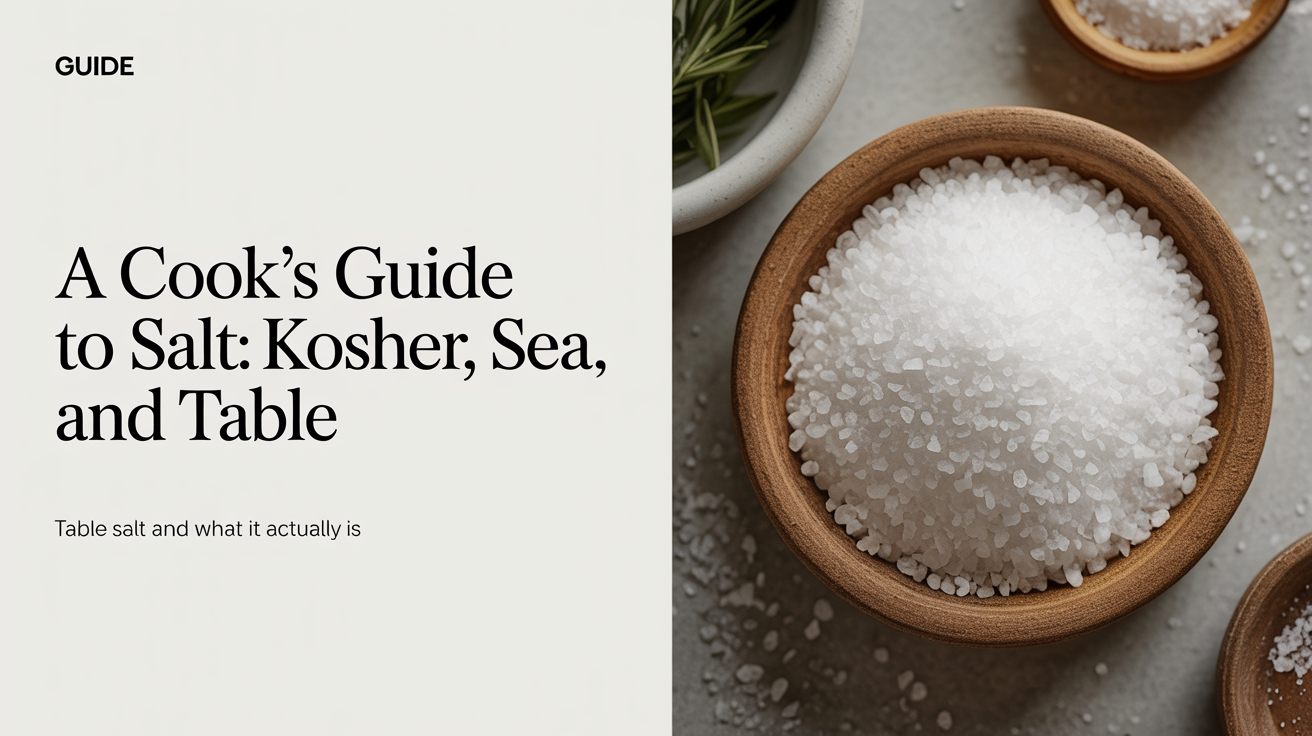
Table salt is finely ground, which means it packs tightly. A teaspoon of table salt has more sodium by weight than the same volume of either kosher brand. It also almost always contains iodine and an anti-caking agent like calcium silicate or sodium aluminosilicate. Iodine fortification isn't a recent health trend. According to the National Institutes of Health's fact sheet on iodine, US salt manufacturers have been voluntarily adding iodine to table salt since the 1920s specifically to prevent iodine deficiency, and iodized salt programs remain the main way most countries address it today.
For most cooking, the iodine and anti-caking agents don't matter. The exception: pickling and fermenting. Table salt can make brines cloudy and, in some ferments, the iodine can inhibit beneficial bacteria. Use non-iodized pickling salt or kosher salt for those applications.
Table salt dissolves fast because the crystals are so fine, which makes it useful for baking, where you want even distribution in a dough or batter. A teaspoon of salt in a sugar cookie needs to dissolve into the fat, not sit in coarse chunks.
Volume conversion: kosher to table
| If the recipe calls for | Diamond Crystal kosher | Morton kosher |
|---|---|---|
| 1/4 tsp table salt | 1/2 tsp | scant 1/2 tsp |
| 1/2 tsp table salt | 1 tsp | 3/4 tsp |
| 1 tsp table salt | 2 tsp | 1 1/4 tsp |
| 1 tbsp table salt | 2 tbsp | 1 1/2 tbsp |
These are approximations. Weight is more reliable: 1 tsp of table salt is about 6 grams regardless of brand, 1 tsp Diamond Crystal is about 3 grams, and 1 tsp Morton kosher is about 4.5 grams.
Sea Salt: What You're Paying For
Sea salt is harvested by evaporating seawater, either in shallow pools or through industrial processing. The result ranges from coarse gray flakes to fine white crystals depending on the source. Most fine-grain sea salts sold for everyday cooking behave nearly identically to table salt in terms of sodium content by volume.
The trace minerals in sea salt (magnesium, calcium, sulfates) are real, but present in such small quantities that they won't affect flavor in a simmering braise. In a delicate application, a finishing salt on a piece of fish, very fine variations in mineral content can be detectable to a careful palate. But that's a marginal difference, and most people won't notice.
For general cooking, fine sea salt and table salt are functionally the same. You're mostly paying for origin story and texture.
Where sea salt earns its place
Coarse sea salt is genuinely useful for two things: crusting meat before a sear (the large crystals create a better exterior texture) and salt-baking whole fish or vegetables, where you pack the food in a thick salt crust to cook it in its own steam. For the latter, you'd go through a pound of salt at a time, so the fancy stuff makes no sense.
Mediterranean-style cooking, where you might want to match ingredients to region, is the one case where using a specific sea salt has some thematic coherence. Pairing good olive oil with a French fleur de sel makes sense on a caprese. Pair the same fleur de sel with a fast-food-style burger and you won't taste the difference.
Finishing Salts: When to Spend the Money
Finishing salts are applied after cooking, just before serving. They stay on the surface of food rather than dissolving in, which means texture matters as much as flavor.
Fleur de sel is hand-harvested from salt ponds in France (primarily Brittany and the Camargue). The crystals are moist, irregular, and dissolve on the tongue in a way that delivers a burst of salinity rather than a steady background note. It's good on chocolate desserts, seared scallops, and anything where you want the salt to announce itself.
Maldon is the most widely available finishing salt in the US and UK. It's a pyramid-shaped flake from Essex, England. The texture is delicate and crunchy, the flavor is clean, and it's versatile enough to use on everything from avocado toast to roast chicken. This is the one to buy if you want a single finishing salt that does most jobs.
Black lava salt and pink Himalayan salt are largely marketing. Pink Himalayan has trace minerals but nothing that affects cooking at normal quantities. Black lava salt gets its color from activated charcoal and is used for visual effect on white or pale foods. Neither is a bad product; they just don't deliver anything a good Maldon can't.
If you're already salting during cooking with kosher salt, a finishing salt is about adding texture and a moment of intense flavor at the end. It's not a substitute for proper seasoning throughout.
Common Mistakes and How to Fix Them
The most common salt error isn't using the wrong type. It's under-salting pasta water and over-salting everything else.
Pasta water should taste like mild seawater. That's about 1 tablespoon of kosher salt per gallon of water. Most home cooks use a quarter of that and wonder why their pasta tastes flat even after they've salted the sauce. The pasta doesn't absorb that much salt from the water, but the surface seasoning matters for how the sauce adheres.
The second common mistake: salting at the end only. Salt draws out moisture and seasons through food when given time. A chicken thigh salted 30 minutes before cooking will be juicier and more evenly seasoned than one salted right before it hits the pan. Fresh herbs benefit from the same principle: salt in a marinade helps break down plant cell walls and distribute flavor.
A third mistake is forgetting that some ingredients are already salty: anchovies, capers, cured olives, miso, soy sauce, Parmesan. If a dish includes two or three of these, it may need no added salt at all. Taste before you season.
Frequently Asked Questions
Can I use sea salt instead of kosher salt in a recipe?
Depends on the grain size. If you have fine sea salt, treat it like table salt and use about half the volume the recipe calls for in kosher salt. If you have coarse sea salt, the grain size is close to Morton kosher and you can approximate a 1:1 swap, but taste as you go. The real answer is to weigh it: aim for the same gram weight the recipe intends.
Why does my food taste salty right after cooking but flat once it cools?
Salt perception is temperature-dependent. Hot food suppresses bitterness and can make saltiness seem lower than it is. Cold food amplifies both bitterness and saltiness. If you're making something served cold, potato salad, pickled onions, gazpacho, season it cold, at serving temperature, and expect it to need less salt than you'd think.
Is expensive salt healthier or lower in sodium?
No. Sodium chloride is sodium chloride. Finishing salts like Maldon or Himalayan pink have the same sodium content by weight as table salt. If anything, using a finishing salt can reduce total sodium slightly because you taste it immediately and need less of it for the same perceived salinity, but that's a marginal effect and depends entirely on how much you use.
What salt should I keep in my pantry?
Two salts cover almost everything: Diamond Crystal kosher for general cooking and a box of Maldon for finishing. If you do a lot of baking from recipes that were tested with table salt, keep a small canister of that too. Beyond those three, additional salts are more about curiosity than utility.