Kitchen Equipment
Why a Kitchen Scale Makes You a Better Baker
Quick Answers
- A cup of flour can weigh anywhere from 120 to 165 grams depending on how it's scooped. That variance is why identical recipes turn out differently.
- Tare the scale between ingredients so you can weigh flour, sugar, and salt straight into one bowl.
- A reliable scale runs $25 to $50, handles 5 kg (11 lb), and reads to 1 gram.
- Bread and pie crust benefit most from weight. Cookies still improve, just less dramatically.
- No scale yet? Spoon flour into the cup until it mounds, then level it. Never scoop straight from the bag.
If you've ever followed a recipe exactly and still turned out a dense cake or crumbly cookies, the problem probably wasn't the recipe. It was your measuring cups.
Baking by weight fixes this. A kitchen scale costs less than a decent bag of bread flour, and it will make you a more consistent baker faster than any other change you can make. Here's what's actually going on and how to use one.
Why volume measurements lie to you
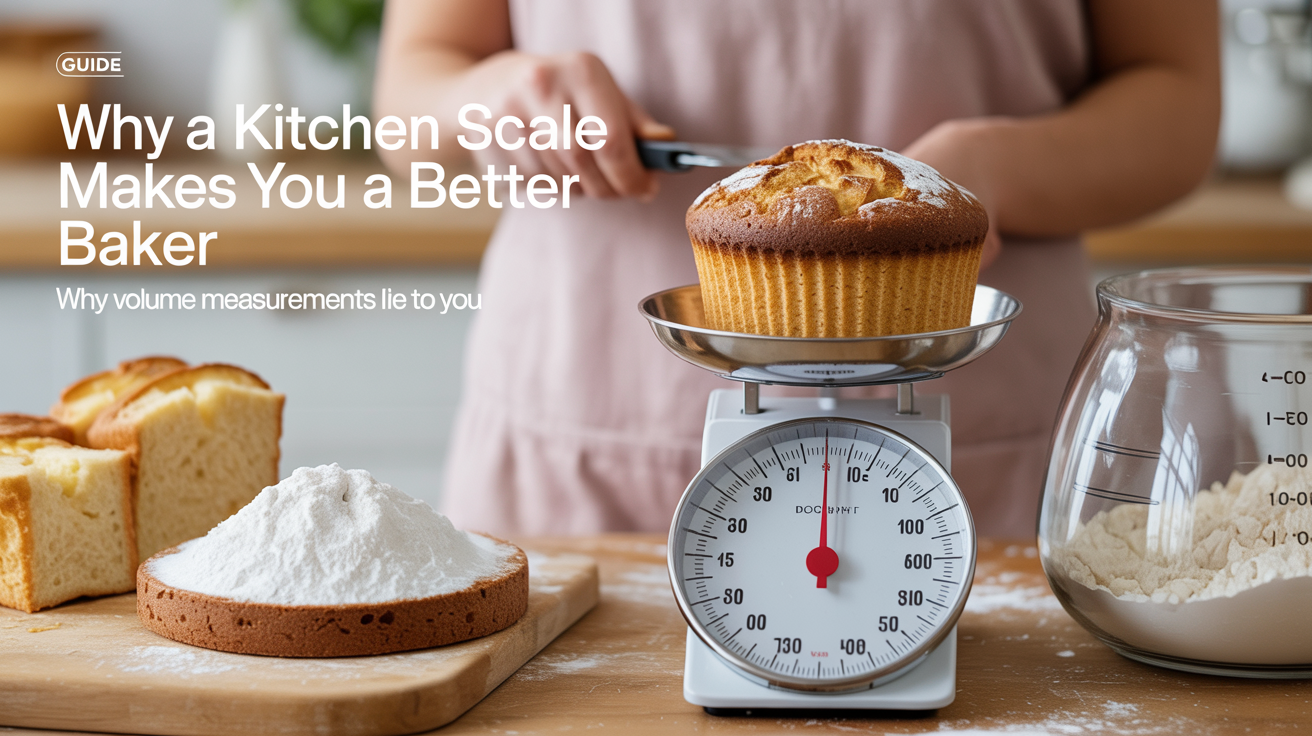
A cup of all-purpose flour can weigh anywhere from 120 to 165 grams depending on how you scoop it. That's a 37% swing. Scoop directly from the bag and you're compacting flour; spoon and level and you get a lighter cup; sift it first and the number drops again.
Professional bakers don't use cups because they can't afford that variance. A batch of croissants or a sourdough loaf lives and dies on flour-to-water ratios (called hydration) that are specific to a single percentage point. Volume measurement doesn't get you there.
Butter compounds the problem. "One stick" is fine if your butter is American and exactly 113 grams per stick. If you buy European-style butter in different packaging, that assumption breaks. Same with brown sugar, which packs into a measuring cup entirely differently depending on humidity and how hard you press.
Weight removes all of that. 240 grams of flour is 240 grams of flour, regardless of brand, sifting, altitude, or how you feel about it.
How to use a kitchen scale (it takes about two minutes to learn)
Tare/zero the scale between ingredients
The tare button resets the display to zero without removing what's already in the bowl. This is the main technique and the one most beginners skip.
Place your mixing bowl on the scale. Press tare. The display shows 0. Add your flour until you hit the target weight. Press tare again. Add sugar. Press tare again. Add salt. You never dirty a single measuring cup, and the math is zero.
This approach also cuts cleanup significantly. Weighing everything directly into the bowl means fewer tools to wash.
Read the recipe in grams, not ounces
Grams win here because they're smaller units. A recipe might call for 3 grams of salt. On a scale that reads in 1-gram increments, that's precise. Three grams in ounces is 0.1 oz, which is genuinely hard to read accurately on most home scales.
If you're converting old recipes, use the gram weights below. Don't convert cups to ounces to grams in two steps; go directly.
For small amounts, use a scale with 0.1g resolution
Most kitchen scales bottom out at 1-gram precision, which works for flour and butter. If you bake bread regularly and need to weigh yeast or salt precisely, look for a model with 0.1-gram resolution. Some bakers keep a small jewelry scale for exactly this purpose.
Common baking ingredient weights
These are approximate figures based on standard density. When a recipe specifies a gram weight, use that; these are for converting older cup-based recipes.
| Ingredient | 1 cup | 1 tablespoon |
|---|---|---|
| All-purpose flour | 125 g | 8 g |
| Bread flour | 130 g | 8 g |
| Whole wheat flour | 120 g | 7.5 g |
| Cake flour | 100 g | 6 g |
| Granulated sugar | 200 g | 12.5 g |
| Brown sugar (packed) | 220 g | 14 g |
| Powdered sugar | 120 g | 7.5 g |
| Butter | 227 g | 14 g |
| Honey | 340 g | 21 g |
| Rolled oats | 90 g | 5.5 g |
| Cocoa powder | 85 g | 5 g |
| Baking powder | n/a | 12 g |
| Kosher salt | n/a | 6 g |
Note that baking powder and salt entries have no cup column because you wouldn't normally measure a full cup of either. Use the tablespoon column and scale from there.
What to look for when buying a scale
Capacity and resolution
For most home baking, a scale with a 5 kg (11 lb) capacity and 1-gram resolution covers everything from a batch of cookies to a large loaf. If you bake enriched doughs or large-batch recipes, go to 11 lbs minimum. Scales with very high capacity sometimes sacrifice resolution at the low end, so check both specs before buying.
Display placement
Look at where the display sits. On some scales, a large bowl or baking sheet hangs over the display and you can't read the number without lifting the bowl. Some models have a pull-out display or a screen that sits at the front of the platform specifically to avoid this. It sounds minor until you're mid-recipe with floury hands.
Waterproofing and cleanup
You will spill on a kitchen scale. Models with a flat stainless steel platform clean faster than ones with raised edges and corners where dough hides. A few scales are rated splash-resistant, which is a reasonable thing to care about near a sink.
Battery life vs. plug-in
Most home scales run on AAA batteries and last for years of normal use. Plug-in models aren't common in home kitchens and aren't worth seeking out unless you're doing very high-volume work. Auto-shutoff (usually after 2 minutes of inactivity) extends battery life but can be annoying mid-recipe; check whether you can disable it.
Price range
A reliable scale costs $25 to $50. Below that range, resolution and durability become unreliable. Above $80 or so, you're mostly paying for stainless steel construction and higher capacity. The middle of that range is where most dedicated home bakers land.
How a scale changes specific recipes
Bread is where the difference is most obvious. Sourdough recipes talk in baker's percentages, where every ingredient is expressed as a percentage of total flour weight. A 75% hydration loaf means 75 grams of water per 100 grams of flour. You cannot do that calculation in cups.
Pie crust is where cup measurements are probably doing the most damage in home kitchens. A correctly made pie crust needs the fat to flour ratio right to within a few grams. Too much flour and the dough is dry and crackly; too much butter and it's greasy and won't hold its shape. Baking by weight turns this from a feel-it-out exercise into a repeatable process.
Cookies are lower-stakes, but even here the difference shows. Chocolate chip cookies where you've measured by weight brown more evenly across a sheet because every cookie has the same mass of dough.
For a sense of the bigger picture on kitchen tools that actually change your results, the pieces on choosing a dutch oven and nonstick vs stainless pans cover similar ground for stovetop work. And if you want to extend the same precision-over-habit thinking to prep tools, the best chef knife guide is worth a read.
FAQ
Can I still use measuring cups if I don't have a scale?
Yes, and plenty of good baking gets done that way. The most consistent cup measurement is the spoon-and-level method: use a spoon to transfer flour into the measuring cup until it mounds above the rim, then sweep a straight edge across the top. Never scoop directly from the bag. This still isn't as accurate as a scale, but it narrows the variance considerably.
Do I need a separate scale for small amounts like yeast?
For active dry or instant yeast, a standard 1-gram scale works in most recipes because amounts are typically 4 to 7 grams. Where this gets tight is fresh yeast or very small amounts of spices. If a recipe calls for 1 gram of something, a scale with 0.1g resolution gives you a more honest read. Most bakers don't need this and can use the 1-gram model for everything.
Are digital scales accurate out of the box?
Generally yes, though accuracy can drift over time or if the scale is dropped. You can check calibration with a known weight: a U.S. nickel weighs exactly 5 grams. Place five nickels on the scale; it should read 25 grams. If it reads 23 or 27, the scale needs recalibration (most models have a cal mode) or replacement.
What's the difference between tare and zero?
On most kitchen scales, they're the same button. Pressing it subtracts the current weight from the display. Where the terms differ technically: zeroing the scale when it's empty corrects for drift (the scale reading, say, 1 gram with nothing on it), while taring subtracts the weight of a container. In practice, pressing the button does both, and most home bakers don't need to worry about the distinction.
Do recipes from other countries assume grams?
Most do, yes. UK, European, and Australian recipes almost always give weights, and they're usually in grams. This is one reason recipes from those traditions often produce more consistent results for home bakers: the measurement system doesn't introduce variance before you even start. When you bake from a British or Scandinavian cookbook, a scale stops being optional.
Sources
- King Arthur Baking: How to Measure Flour the Right Way breaks down why the same cup of flour can weigh 120 to 160 grams depending on technique.
- King Arthur Baking: Hydration in Bread Dough, Explained covers how baker's percentages and hydration levels affect dough handling.