Kitchen Equipment
Stand Mixer Attachments Worth Owning
The Gist
- The three attachments in the box (flat beater, dough hook, whisk) cover most baking. Everything else is optional.
- The food grinder and pasta roller are the two extras that genuinely change how people cook, if you use them regularly.
- The spiralizer, citrus juicer, ice cream maker, and grain mill are all "worth it only at a specific volume or habit" purchases.
- Grinding your own meat means the interior gets exposed to whatever bacteria was on the surface, so cook ground meat to a safe internal temperature, same as store-bought.
- Cheap third-party attachments flex and wobble under load. For the grinder and pasta roller, quality is worth paying for.
Your stand mixer came with three attachments. Most people use one of them 90% of the time. The rest of the stand mixer attachments universe is a maze of promises and price tags, and frankly, most of it collects dust.
Here's the honest rundown: what each attachment does, whether it earns its keep, and who can skip it entirely.
The three that came in the box
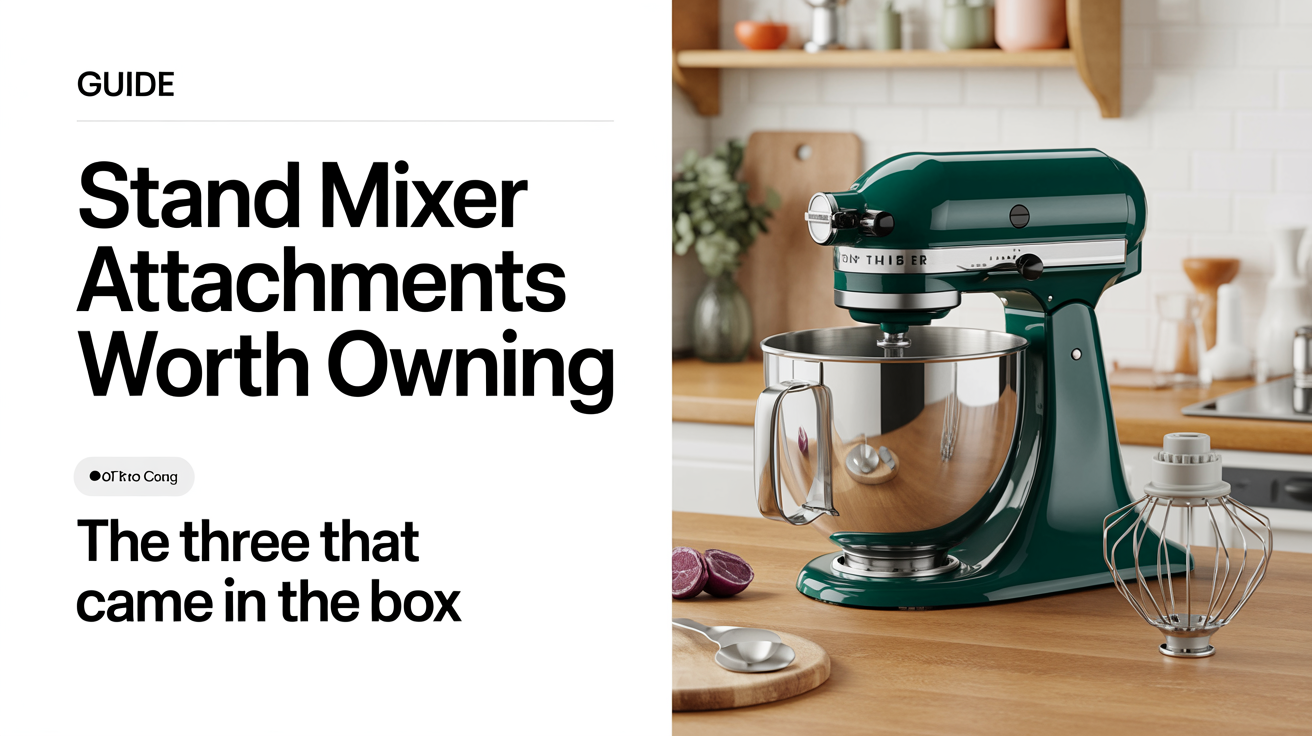
Before getting into extras, it helps to be clear on what the stock set actually covers.
- Flat beater (paddle): Your workhorse. Cookies, cakes, meatloaf, mashed potatoes. If you only ever use one attachment, this is the one.
- Dough hook: Bread, pizza dough, bagels. Does a decent job for most home bakers, though it won't outperform hands for small batches.
- Wire whisk: Whipped cream, egg whites, light batters. Don't use this for thick doughs; it will bend.
If these three cover what you cook, the rest of this article is about whether anything else is worth adding.
Attachments that actually earn their space
The food grinder
This is the one add-on that consistently changes how people cook. Fresh-ground beef for burgers has noticeably better texture than pre-ground, because you control the fat ratio and grind coarseness. Same goes for pork sausage. You also get a stuffing tube for making links, though that requires some practice to not end up with air pockets.
The grinder works through the power hub at the front of the machine, so no separate motor. It's slower than a dedicated grinder, but unless you're processing 10-pound batches regularly, the speed is fine.
Grinding at home does change the food safety picture slightly: whole cuts of meat are sterile inside, and grinding exposes that interior to whatever bacteria is on the surface, on the blade, or on your hands. That's true whether the grinding happens at a plant or your counter, and it's why ground meat, home-ground or store-bought, needs to be cooked through rather than left rare.
Who should get it: anyone who grinds meat more than once a month, or who makes sausage. Skip it if you buy pre-ground and have no interest in changing that.
The pasta roller and cutter set
Fresh pasta at home is a different product than dried pasta from a box. It's typically made with eggs and all-purpose flour rather than semolina and water, cooks in about half the time, and doesn't expand the way dried pasta does, so a given weight of fresh dough serves fewer people than the same weight dried. The texture is softer and takes delicate sauces better, while dried pasta holds up in heartier, longer-cooked dishes. A dedicated hand-crank pasta machine does the same rolling job for less money, but it requires two hands (one to crank, one to guide the dough) or a second person. The stand mixer roller leaves both hands free to guide the sheet.
The set typically includes a roller, a spaghetti cutter, and a fettuccine cutter. Additional cutter shapes cost extra.
Who should get it: people who make pasta regularly and want the process to be less awkward. Skip it if you only make pasta occasionally; a hand crank is $30 and works fine.
The spiralizer
Three functions: spiral slicing (zucchini noodles, curly fries), ribbon cutting, and straight-blade slicing. The stand mixer's motor handles hard vegetables like beets and sweet potatoes without the hand fatigue of a manual spiralizer.
Who should get it: if you spiralize vegetables more than once or twice a week and find a manual tool annoying. Otherwise this is a specialty purchase that most home cooks don't need.
The middle ground: useful but replaceable
The citrus juicer
Attaches to the power hub and spins a reamer. It works well enough, produces no wrist strain, and handles large volumes (think: juicing two dozen oranges for a party) more comfortably than a handheld tool.
But for everyday juice, a $15 manual juicer does the same job in 30 seconds. The attachment costs significantly more and requires setup and cleanup of a larger piece of equipment.
Verdict: only worth it if you juice in volume regularly.
The ice cream maker
A bowl with a built-in freezer insert that churns while the flat beater paddle scrapes the sides. Produces decent ice cream, gelato, and sorbet.
The limitation: the bowl needs 15 hours in the freezer before use. Spontaneous ice cream is not happening. A standalone ice cream maker with a compressor lets you churn back-to-back batches without waiting.
Verdict: fine if you plan ahead and make one batch at a time. Not great if you want flexibility.
The grain mill
Grinds whole wheat berries, dried corn, rice, and similar grains into flour. If you bake with fresh-milled whole grain flour, this attachment is genuinely useful. Fresh-milled flour has more oils intact, which changes the flavor and shelf life of bread, generally for the better in the first days after milling and then working against you as those oils start to turn.
The problem: it's slow, and it runs the motor hard. Manufacturers typically recommend not milling for more than about 8 minutes continuously. For small batches this is fine; for serious volume it gets tedious.
Verdict: worth it for dedicated whole-grain bread bakers. Most home cooks can skip it.
Attachment ratings at a glance
| Attachment | Best for | Worth buying? | Can skip if... |
|---|---|---|---|
| Food grinder | Fresh-ground meat, sausage | Yes, for regular use | You don't grind meat at home |
| Pasta roller/cutter | Fresh pasta without a second pair of hands | Yes, for regular pasta makers | You make pasta rarely |
| Spiralizer | High-volume vegetable spiraling | Maybe | You don't spiralize weekly |
| Citrus juicer | Juicing large volumes | Only at scale | You juice small amounts |
| Ice cream maker | Planned-ahead frozen desserts | Maybe | You want spontaneous batches |
| Grain mill | Fresh-milled whole grain flour | Yes, for serious bread bakers | You buy flour from the store |
| Slicer/shredder | Grating hard cheeses, slicing in bulk | Marginal | Your box grater handles it fine |
What the slicer/shredder attachment is actually like
This comes up because it's frequently marketed as a time-saver for cheese, vegetables, and bread. In practice, for a small block of cheese or two carrots, it takes longer to set up, run, and clean the attachment than to use a box grater. The break-even point is somewhere around a pound of cheese or a large batch of sliced vegetables.
The slicer blade for cutting potatoes into chips is more genuinely useful than the shredder, since the consistent thickness matters there in a way it doesn't for salad carrots. But most people with one of these attachments end up reaching for the grater anyway for everyday tasks.
A note on compatibility and cost
Most major stand mixer brands use a universal power hub design, meaning third-party attachments often work alongside the brand-name ones. That said, attachment quality varies a lot by manufacturer, and cheaper knockoffs have a reputation for flex and wobble under load. For the grinder and pasta roller especially, the extra cost of a quality attachment is worth it. These are tools you'll use for years.
If you're buying a stand mixer specifically to expand into these attachments, it's worth reading about the best chef's knife too, since good knife work often does the job faster for small prep tasks than swapping out equipment. Similarly, having the right pots matters as much as the prep equipment; see dutch oven uses for where that tool fits.
For finishing tasks at the stove, your pan choice affects results as much as your mixer does. The breakdown in nonstick vs stainless steel pans is relevant if you're outfitting a kitchen more broadly.
FAQ
Are stand mixer attachments interchangeable between brands?
Generally, no. The power hub size and fitting differ between brands. Some third-party manufacturers make attachments that fit multiple brands, but always check the compatibility specs before buying. Attachments labeled for one brand may not lock securely onto another.
Which kitchenaid attachments does a beginning baker actually need?
None beyond the three that came with the machine. The flat beater, dough hook, and whisk cover everything in most baking books. Once you're comfortable with those and find yourself wanting fresh pasta or fresh-ground meat, then specific attachments start to make sense.
Is the pasta roller attachment worth the price over a hand-crank machine?
If you make pasta alone, yes. The stand mixer roller frees both hands to guide the dough sheet, which makes a real difference in getting even thickness. If you always cook with a partner who can help with the hand crank, the cheaper standalone machine is fine.
Can you use these attachments for savory cooking, not just baking?
Several of them are better suited to savory cooking. The food grinder is primarily for meat. The spiralizer is mostly for vegetables. The pasta roller makes pasta. The stand mixer's stand mixer uses extend well beyond baking once you start adding attachments.
How do you clean stand mixer attachments?
Most are dishwasher safe on the top rack, but check the manual for your specific attachment. The pasta roller is an exception: water warps the wooden rollers on some models. Brush pasta flour out dry, then wipe with a barely damp cloth. The grinder disassembles and all metal parts go in the dishwasher; just make sure they're fully dry before storing to prevent rust on the cutting blade.
Sources
- Clemson Cooperative Extension: Safe Handling of Beef explains why grinding exposes the interior of meat to surface bacteria and why ground beef needs thorough cooking.
- Wikipedia: Pasta covers the practical differences between fresh egg pasta and dried semolina pasta in cook time, texture, and how much each yields per pound.